Critical infrastructure
Theft answered before the line goes down, with evidence that holds up afterwards.
Aerial overwatch, flown by licensed pilots
Your alarms launch it. Our licensed pilots watch every flight.
What we do
We keep a permanent watch in the air above your ground. By night it keeps crime away. By day it inspects what you own. It never goes home.
Flown by licensed pilots from a 24/7 operations room. Delivered as a service, nothing for you to buy or fly.
Two pillars
The problem
You already have beams, cameras and alarms. They record what happened. They cannot stop it. Everything comes down to the minutes between the alarm going off and someone actually seeing what is out there. That gap is when the loss happens.
Rural armed response takes 45 to 90 minutes. We are overhead in under two minutes.


The solution
A Pharos station sits on your ground. A beam trips, or your control room calls it in, and the aircraft is overhead in under two minutes. A licensed pilot flies it, looking at thermal, and tells you what is actually there before anyone gets in a vehicle.
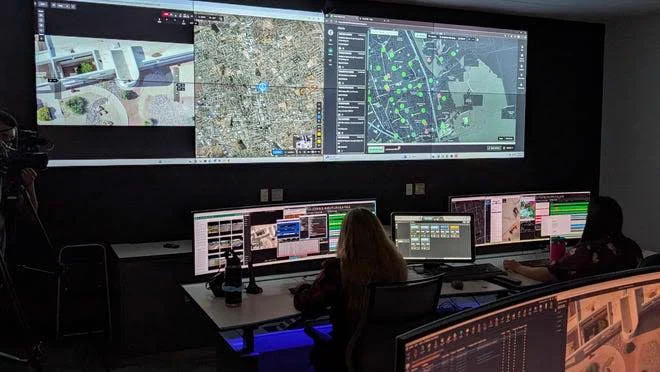
The operations room
A licensed pilot watches every flight from an operations room that runs 24/7. The automation flies the aircraft. A person makes every decision that matters, and their name is in the log.
Most aerial response falls apart at the handover, when nobody can reach anybody. So we built the direct phone link to your control room before we built anything else.
Your window
Every client gets the Pharos app. When your site goes live, so does your screen.


Shown with demonstration data.
The same thermal view our pilots see, as the response happens.
The first line answers the only question that matters: is everything all right.
Every patrol and every response is kept for 30 days under your service agreement. If your armed response or your insurer needs it, you hand it over.
Works on any phone. Nothing to install. Book a site assessment and your screen goes live.
The service
Your security, amplified
You have already built the structure. Guards, cameras, a control room. There is one gap in it. Nobody sees the whole site at the moment something starts. The aircraft flies a pattern nobody can time, and it picks up a warm body in the dark long before a torch would. When something moves, it is overhead in under two minutes, and your guards get a live position instead of a guess.

The machine
A sealed station that sits on your ground. Built on DJI hardware, then hardened by us for the load shedding, dust and heat we actually get here.
An outage does not stop the watch. When your power goes, the station keeps flying and keeps reporting.
The aircraft
A Matrice 4TD, flown by licensed pilots. It takes off, flies the pattern and returns to charge on its own, with a pilot watching the whole time.


Anyone who has cased your site knows where the cameras stop and when the guards change over. A patrol in the air is much harder to learn from the ground, and much harder to plan around.

A camera stays where you put it. An aircraft does not.
Detection runs on the aircraft itself, not on a server in another country. The footage goes only to the people you have named.
A privacy feature first, a technology feature second.
Compliance first, by design.
We fly under SACAA Part 101 with licensed pilots. We are working through night approvals and BVLOS approvals, both ahead of our first deployments in 2026. BVLOS lets a pilot fly beyond visual line of sight. Footage is handled under POPIA, and the Information Officer is named and the retention period published before the first station ever flies. What happens to anything you send us through this site is already written down in our privacy notice. Ask us anything. We would rather you check.
The only person who feels observed on a Pharos site is the one who climbed the fence.
Find your ground
Theft answered before the line goes down, with evidence that holds up afterwards.
What a helicopter gives you, without paying for helicopter hours. Thermal patrols through the poaching window, every night.
A layer above your guards. Fewer vehicles rolled for nothing, and every real incident confirmed first.
Who we are
Pharos is named for the lighthouse of Alexandria, the first structure built purely to keep watch through the night. We were founded in Cape Town in the shadow of Umlindi Wemingizimu, the Watcher of the South.
Nine years and about 480 hours flying this country showed us how much of it nobody is watching after dark. The person who built the safety case is the person who answers the phone and walks your survey.
pharos.

Licensed remote pilot since 2017, nine years flying commercially in South African conditions, about 480 hours of it. Builds and flies the system, and leads the SACAA BVLOS pathway.
The company’s PSIRA and POPIA standing sits with the founder.
Our mission is to keep the light on over the places that matter most, so no property worth protecting is unwatched after dark.
Book a site assessment
Give us a morning on your property and you get five things back. A map of exactly what we can cover. Where the stations go. A power plan built around the load shedding you actually get. Where you stand on airspace and approvals. And a fixed price. It costs you nothing and you are not committing to anything. There are two ways to start, and both end in the same place.
One
Tell us where you are and what you are protecting. The founder calls you back inside one business day, and brings the assessment to you.
Use the form belowTwo
Draw your property on a satellite map and answer four questions. You see a rough plan for your own ground before you talk to anyone, and what you drew comes through to us with it.
Check your site, two minutesWe are taking five founding sites for 2026. They go to operators, reserves and estates who want this first. You will not be a test. You will be first.
Received.
The founder calls you within one business day.
Sooner is better. WhatsApp or call 074 132 8500.